
Railroad Crossing Safety Signs: What Every Driver Needs to Know
Every year, roughly 2,000 collisions occur at railroad crossings in the United States, and the vast majority involve drivers who either didn’t see the warning signs or didn’t understand what they meant. A loaded freight train weighs about 6,000 tons and takes over a mile to stop, which means the burden of avoiding a collision falls entirely on you.
Railroad crossing signs are the traffic control devices designed to give you that chance. This guide covers every type of sign you’ll encounter, from advance warnings to crossbucks to pavement markings, along with the rules for responding to each one safely.
What is a railroad crossing sign
A railroad crossing sign is a traffic control device that warns drivers of an upcoming intersection between a road and railroad tracks. When you see one, it’s telling you to slow down, watch for trains, and be ready to stop. These signs exist because trains can’t stop quickly. A freight train traveling at 55 mph takes about a mile to come to a complete halt, so the responsibility falls on drivers to yield.
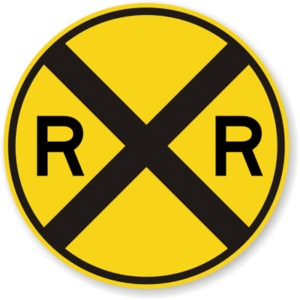
All railroad crossing signs in the United States follow standards set by the Manual on Uniform Traffic Control Devices (MUTCD). This federal guideline ensures that whether you’re driving through rural Kansas or downtown Chicago, you’ll recognize the same warnings. That consistency saves lives.
Types of railroad crossing signs
Railroad crossing signs fall into three main categories, and each one communicates something different to drivers.
1. Regulatory signs
Regulatory signs tell you what the law requires. At railroad crossings, you’ll typically see stop signs or yield signs positioned right at the tracks. These signs feature white backgrounds with black or red text and ignoring them can result in a traffic citation or worse.
2. Warning signs
Warning signs give you advance notice that something requires your attention ahead. The classic example is the round yellow sign with a black X and two R’s, which appears before you reach the crossing itself.
3. Guide signs
Guide signs provide useful information without commanding any specific action. At railroad crossings, the most common guide sign is the blue Emergency Notification System (ENS) sign. It displays a phone number and a unique identifier for that specific crossing, so you can report emergencies or malfunctions.
4. Railroad advance warning signs
Advance warning signs appear well before the actual crossing, giving you time to slow down and prepare. How far in advance? That depends on the speed limit. Faster roads require more warning distance.
5. Railroad crossing ahead sign W10-1
The W10-1 sign is probably the most recognizable railroad warning sign in America. It’s the round yellow sign with a black X and the letter R on each side. Unlike most warning signs, which are diamond-shaped, this one is circular. That unique shape makes it instantly identifiable, even from far away or in bad weather.
Advance warning sign placement
On a road with a 25 mph speed limit, you might see the advance warning sign about 100 feet before the crossing. On a highway with a 55 mph limit, that distance stretches to 500 feet or more. The goal is simple: give drivers enough time to react safely at whatever speed they’re traveling.
- Pavement markings at railroad crossings : Signs aren’t the only warnings at railroad crossings. Pavement markings painted directly on the road reinforce the message, especially when signs might be hard to see.
- Railroad crossing pavement symbols : A large white X with the letters RR painted on the pavement tells you a crossing is ahead. These markings appear in your lane of travel before you reach the tracks. Even if a sign is blocked by a truck or obscured by overgrown vegetation, the pavement marking gives you a second chance to notice the warning.
- Stop lines at railroad crossings : White stop lines painted across the lane show you exactly where to stop. These lines sit at least 15 feet back from the nearest rail, which keeps your vehicle clear of passing trains and any cargo that might swing wide on curves.
Crossbuck signs and signals at the crossing
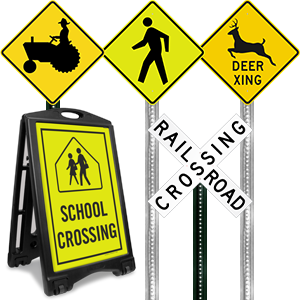
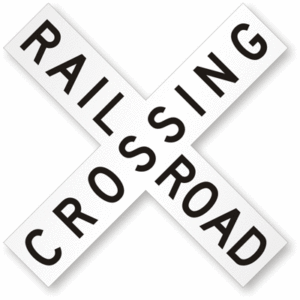
While advance warning signs tell you a crossing is coming, the crossbuck marks the spot where you actually encounter the tracks. It’s the white X-shaped sign that says “Railroad Crossing,” and it’s been a fixture at American crossings for over a century.
| Device Type | What It Looks Like | What You Do |
| Crossbuck sign (passive) | White X with “Railroad Crossing” text | Yield to any train you see or hear |
| Flashing lights (active) | Alternating red lights | Stop and wait until lights stop flashing |
| Automatic gates (active) | Red and white striped arms | Stop and never drive around them |
Standard crossbuck sign R15-1
The R15-1 crossbuck is a white reflective sign shaped like an X, with the words “Railroad Crossing” split across the two arms. Here’s something many drivers don’t realize: this sign legally functions as a yield sign. If there’s no stop sign, flashing lights, or gates, you’re still required to yield to any train that’s approaching or occupying the crossing.
- Flashing light signals :Flashing red lights at a crossing mean a train is approaching. Once those lights start flashing, you stop and stay stopped until they go dark and you can confirm no train is coming. The lights activate automatically when sensors detect an approaching train, typically giving about 20 seconds of warning before the train arrives.
- Automatic railroad gates : Crossing gates add a physical barrier to the warning system. When a train approaches, the gates lower across the roadway to block traffic. Driving around lowered gates is illegal everywhere in the United States, and it’s one of the leading causes of fatal collisions at railroad crossings.
- What to do when approaching a railroad crossing : Knowing what the signs mean is only half the equation. How you respond to them determines whether you cross safely.
Approaching the crossing safely
As you get close to any railroad crossing, slow down and reduce distractions. Turn down your music and consider rolling down your window. Train horns are loud, but they’re easier to hear without barriers. Look both ways along the tracks, even if no warning signals are activated.
Stopping and yielding at the crossing
Several situations require you to stop at a railroad crossing:
- Stop sign posted: Treat it like any other stop sign. Come to a complete stop before proceeding.
- Flashing lights activated: Stop and remain stopped until the lights stop flashing.
- Gates lowered: Stop and wait for gates to fully raise before crossing.
- Train visible or audible: Stop regardless of what the signals show.
Crossing the tracks
Once you’ve confirmed it’s safe, proceed across without stopping on the tracks themselves. If traffic is backed up on the other side, wait until there’s room for your entire vehicle to clear the crossing.
If your vehicle stalls on the tracks, get out immediately. Move away from the crossing at an angle, in the direction the train is coming from. This protects you from debris if there’s a collision. Then call 911 or the number on the ENS sign.
How far to stop from a railroad crossing sign
When you stop at a railroad crossing, your vehicle’s front bumper should be no closer than 15 feet from the nearest rail. Most states also set a maximum distance of 50 feet. This zone keeps you close enough to see clearly while staying far enough back to avoid a passing train or swinging cargo.
MUTCD requirements for railroad crossing signs
Every railroad crossing sign on a public road in America follows MUTCD standards. These federal requirements cover everything from colors and sizes to placement and reflectivity.
– Sign dimensions and colors : Warning signs use yellow backgrounds with black text and symbols. Regulatory signs like crossbucks use white backgrounds. Sign sizes vary based on road type. Higher-speed roads require larger signs that drivers can read from farther away.
– Reflectivity standards for railroad signs : Railroad crossing signs require retroreflective sheeting, which bounces your headlights back toward you. This makes signs visible at night and in rain, fog, or snow. Signs that have faded or lost their reflective properties no longer meet safety standards and require replacement.
– Emergency notification system signs : Blue ENS signs appear at crossings throughout the country. Each sign displays a toll-free phone number and a unique DOT crossing identification number. If you see a vehicle stuck on the tracks, malfunctioning signals, or any other emergency, this sign gives you the information to report it quickly to the right people.
Frequently asked questions about railroad crossing signs
Question 1. What is the penalty for ignoring a railroad crossing sign?
Answer: Penalties vary by state but typically include fines between $100 and $500, plus points on your driving record. Violations involving active warning devices like running a gate or ignoring flashing lights often carry steeper fines. Repeat offenders may face license suspension.
Question 2. Are railroad crossing signs required on private property?
Answer. Private railroad crossings don’t always fall under the same regulations as public crossings. However, installing proper signage reduces accident risk and can provide liability protection if someone is injured on your property.
Question 3. How often should railroad crossing signs be replaced?
Answer. Signs require replacement when their reflectivity fades below acceptable levels, when physical damage affects visibility, or when MUTCD standards change. Annual inspections help identify signs that no longer meet safety requirements.
Question 4. What is the difference between a W10-1 and W10-2 sign?
Answer. The W10-1 is the circular advance warning sign placed on roads that cross railroad tracks. W10-2 signs appear on parallel roads to warn drivers about crossings on intersecting side streets, alerting them to potential train traffic even though they’re not crossing the tracks themselves.
Category: Crossing Sign
