
Understanding the Importance of Yield Signs
A yield sign is a regulatory traffic sign that instructs drivers to slow down, check for oncoming traffic, and give the right of way to other vehicles or pedestrians before proceeding. Unlike a stop sign, it doesn’t require a complete stop when the path is clear, just a reduction in speed and readiness to wait if someone else has priority.
This guide covers what yield signs mean, how they differ from stop signs, where you’ll encounter them, and how they manage traffic safely.
What is a yield sign
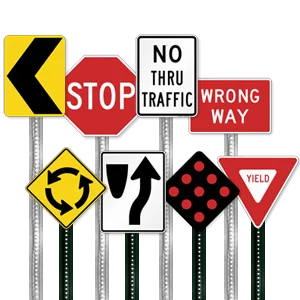
A yield sign is a regulatory traffic sign that tells drivers to slow down, prepare to stop if necessary, and give the right of way to other vehicles or pedestrians before proceeding. The sign features an inverted red-bordered white triangle with “YIELD” printed in red, a design that’s instantly recognizable on roads throughout the United States and internationally.
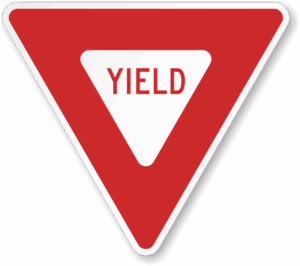
Unlike a stop sign, a yield sign doesn’t require you to come to a complete stop when the path is clear. Instead, it asks you to reduce speed, assess the situation, and let others go first if they have priority. Think of it as a conditional instruction: proceed if it’s safe, but be ready to wait if it’s not.
You’ll typically encounter yield signs at intersections, highway on-ramps, roundabouts, and anywhere traffic from different directions merges into a shared lane.
What the yield sign means for driving
When you see a yield sign, you’re being asked to make a judgment call rather than follow an absolute rule. Slow down as you approach, scan for oncoming traffic, and decide whether you can safely merge or continue. If vehicles or pedestrians have priority, you wait for them. If the road is clear, you keep moving.
This flexibility is exactly what makes yield signs confusing for some drivers. At a stop sign, the expectation is clear: stop completely, then go. At a yield sign, the required action depends entirely on what’s happening around you.
The key distinction is this: “yield” means “give way.” You’re entering a space where others may have the right to go first, and your job is to recognize when that’s the case.
What to do at a yield sign
Approaching a yield sign involves a consistent sequence of actions:
– Slow down and assess traffic: Reduce your speed as you get closer and look for vehicles, cyclists, and pedestrians from all directions.
– Yield the right of way: If traffic is approaching on the main road or someone is already in the intersection, come to a complete stop and wait for a safe gap.
– Proceed when the path is clear: Once you’ve confirmed no one has priority, merge or continue through smoothly.
The important point here is that stopping isn’t always required, but being prepared to stop always is. If visibility is limited or traffic is heavy, treating the yield sign like a stop sign is the safer approach.
What does a yield sign look like
The yield sign’s distinctive appearance sets it apart from every other traffic sign on the road.
1. Shape and color
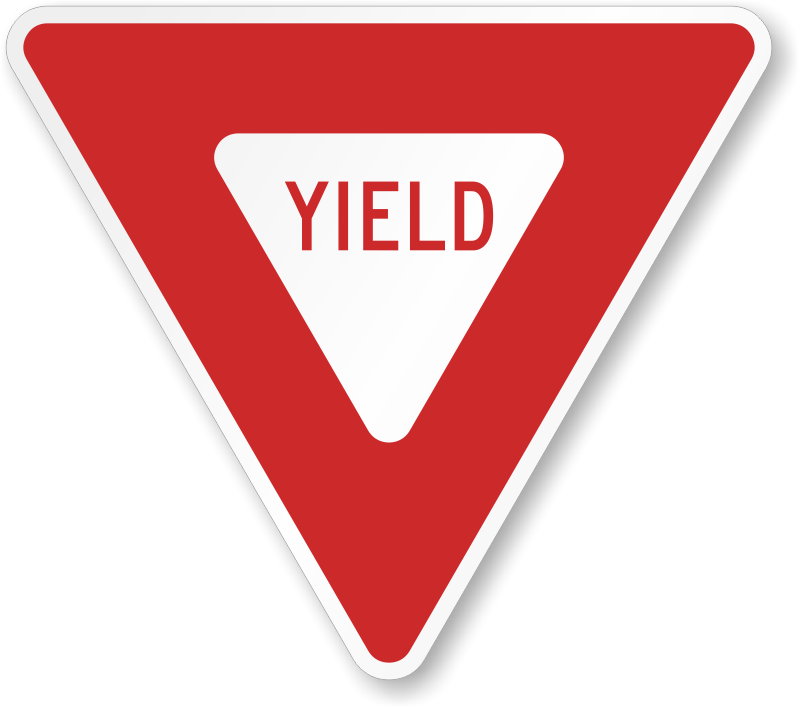
Yield signs use an inverted equilateral triangle, which is the only road sign shape that points downward in the United States. The design features a thick red border surrounding a white center, with “YIELD” printed in bold red letters. This combination of unique shape and high-contrast colors helps drivers identify the sign quickly, even from a distance or in poor weather.
2. Standard dimensions
On public roadways, yield signs typically measure 36 inches on each side, though smaller versions appear in lower-speed areas like parking lots. Signs on private property can vary in size depending on traffic speed and the specific application.
3. Reflectivity requirements
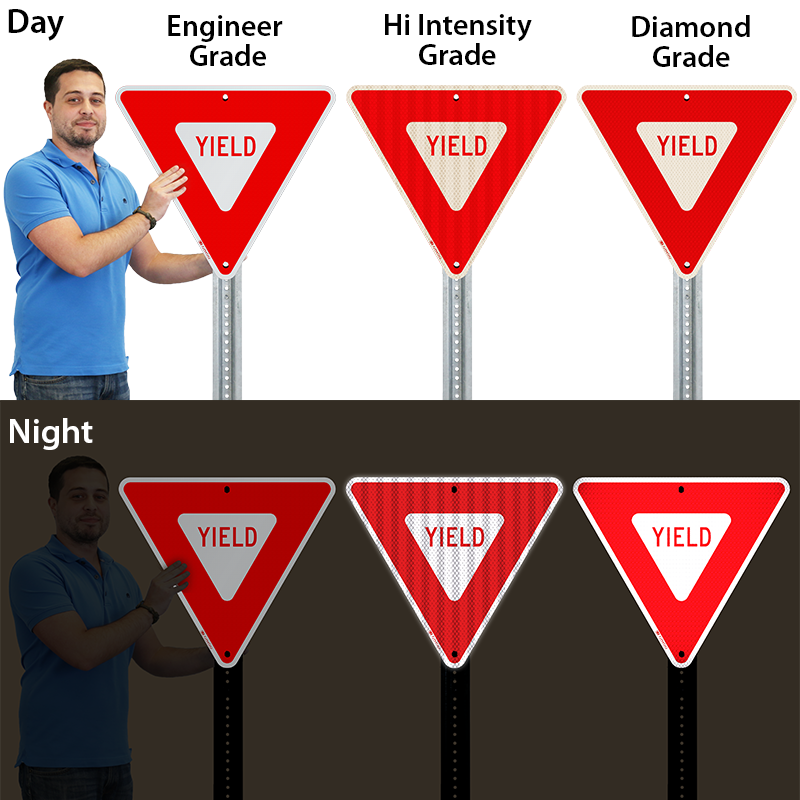
All yield signs on public roads are retroreflective, meaning they bounce light back toward its source. When your headlights hit a yield sign at night, the sign appears to glow brightly, making it visible from several hundred feet away. This retroreflective sheeting is a federal requirement for traffic control devices.
Yield sign vs. stop sign
Both signs regulate right of way at intersections, but they ask drivers to do different things.
| Feature | Yield Sign | Stop Sign |
| Shape | Inverted triangle | Octagon |
| Color | Red and white | Red and white |
| Required action | Slow and yield if needed | Complete stop required |
| Typical placement | Merging lanes, roundabouts, low-traffic intersections | High-traffic intersections, school zones, crosswalks |

Yield signs and traffic law
Yield signs are regulatory signs, which means they carry legal weight. Ignoring one can result in a traffic citation, and in the event of an accident, failure to yield often determines who’s at fault.
– Right of way rules
The driver facing a yield sign does not have the right of way. Vehicles on the main road, cars already circulating in a roundabout, and pedestrians in crosswalks all take priority. The yielding driver enters only when doing so won’t force others to slow down or change course.
– Penalties for failing to yield
A failure-to-yield violation typically results in a traffic ticket, points on your driving record, and fines that vary by state and municipality. More significantly, if a collision occurs because you didn’t yield when required, you’ll likely be found at fault.
Where yield signs are used
Yield signs serve important purposes on both public roads and private property.
– Public roadways and intersections
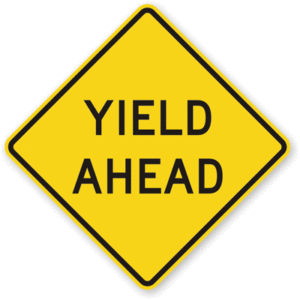
Common placements include roundabout entries, highway merge lanes, T-intersections where a smaller road meets a through street, and pedestrian crossings. In each case, the sign clarifies who goes first when traffic paths cross.
– Private property applications
Property owners frequently install yield signs to manage traffic flow in parking garages, apartment complexes, and commercial entrances. Homeowners associations, office parks, and shopping centers use yield signs on private roads to prevent confusion and reduce accidents.
– Yield signs in workplace settings
Beyond roadways and parking lots, yield signs play a critical safety role inside facilities where vehicles and pedestrians share space.
– Warehouse and manufacturing facilities
Forklifts, pallet jacks, and other powered industrial vehicles create collision risks at blind corners and aisle intersections. Yield signs remind operators to slow down and check for cross traffic before proceeding.
– Forklift and pedestrian traffic zones
Yield signs at transition points where pedestrian walkways cross vehicle lanes remind forklift operators to give way to workers on foot.
How to choose the right yield sign
Selecting the right signage depends on where you’re installing it, what regulations apply, and what specific hazards you’re addressing.
Material options
Aluminum signs hold up well in outdoor conditions and typically last for years without fading or corroding. Plastic signs offer a lighter, more economical choice for indoor applications.
MUTCD compliance
The Manual on Uniform Traffic Control Devices (MUTCD) is the federal standard that governs signs on public roads in the United States. Private facilities aren’t legally bound by MUTCD standards, but following them ensures your signs communicate clearly to anyone familiar with standard traffic control.
Frequently asked questions about yield signs
Question 1. Does yield mean I have to stop completely?
Answer. Not necessarily. Yield means slow down and stop only if traffic is present or if you can’t safely proceed. If the path is clear and no one has the right of way, you can continue without coming to a full stop.Question 2. Is a yield sign yellow or red?
Answer. Modern yield signs are red and white. The original 1950 design used yellow and black, but that color scheme was phased out in 1971 to improve visibility and align with international standards.Question 3. Who has the right of way at a yield sign?
Answer. Traffic on the main road or intersecting street has the right of way. The driver facing the yield sign waits until proceeding won’t interfere with other vehicles or pedestrians.Question 4. Can I install a yield sign on private property?
Answer. Yes. Property owners can install yield signs on private roads, parking lots, and facilities to direct traffic and establish right-of-way expectations. While these signs may not carry the same legal weight as public road signs, they help prevent accidents and communicate expected behavior.
Category: Stop Signs, Yield Sign
