
What Are Stop Signs? Complete Guide to Traffic Stop Signs
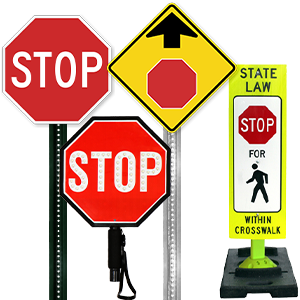
A stop sign is a red, octagonal traffic control device that requires drivers to come to a complete stop before proceeding. Its distinctive eight-sided shape and bold white lettering make it one of the most universally recognized signs in the world, identifiable even from behind or when partially obscured.
This guide covers everything from MUTCD compliance standards and reflectivity requirements to the different types of stop signs available for public roads, private property, and industrial facilities.
What is a stop sign
A stop sign is a red, octagonal traffic sign that requires drivers to come to a complete halt before proceeding through an intersection or crossing. Unlike yield signs that allow drivers to slow down and continue if the way is clear, stop signs demand a full stop (no rolling through). The sign’s purpose is straightforward: control right-of-way, prevent collisions, and give drivers a moment to check that it’s safe to proceed.
You’ll encounter stop signs at intersections, railroad crossings, parking lot exits, and anywhere else traffic patterns create collision risks. The red color and eight-sided shape are recognized worldwide, which means even drivers unfamiliar with local languages understand exactly what the sign is asking them to do.
Stop sign shape, color, and design
Every element of a stop sign’s design serves a specific purpose. The shape, color, and lettering all work together to grab attention and communicate a clear message quickly.
Why stop signs are octagon shaped
The octagon is the only eight-sided shape used for traffic signs, and that’s intentional. Because no other sign shares this profile, drivers can identify a stop sign even when viewing it from behind, at an angle, or when snow and dirt cover the text.
This standardization goes back to the 1920s, when traffic engineers realized that distinct shapes could communicate meaning faster than words alone. A driver approaching an intersection doesn’t have time to read. They recognize the shape first, then react. Today, the octagon is recognized internationally, making stop signs effective regardless of what language a driver speaks.
Stop sign color and lettering
Stop signs feature a red background, a white border, and the word “STOP” in bold white capital letters. Red signals danger or the need to halt in nearly every culture, which is why it was chosen for this critical sign.
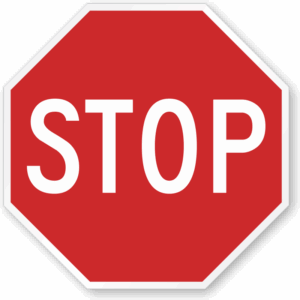
The high contrast between red and white ensures readability across different lighting conditions. Modern stop signs also use reflective materials that bounce headlight beams back toward drivers at night, maintaining visibility when natural light isn’t available.
Standard stop sign dimensions
Stop signs come in several sizes, each suited to different traffic speeds and viewing distances.
| Size | Dimensions | Typical Use |
| Small | 18″ x 18″ | Parking lots, private driveways, low-speed areas |
| Standard | 24″ x 24″ | Residential streets, most public intersections |
| Intermediate | 30″ x 30″ | Collector roads, busier intersections |
| Oversized | 36″ x 36″ | High-speed roads, limited visibility locations |
The right size depends on how fast traffic approaches and how much time drivers have to recognize and respond to the sign.
MUTCD stop sign requirements
The Manual on Uniform Traffic Control Devices (MUTCD) is the federal standard that governs traffic sign specifications across the United States. Published by the Federal Highway Administration, the MUTCD ensures that a stop sign in Maine looks and functions exactly like one in California.
For public roads, MUTCD compliance isn’t optional. Even on private property, following these standards helps ensure drivers immediately understand your signage without any confusion.
Reflectivity standards
Reflectivity describes how well a sign bounces vehicle headlights back toward the driver. At night, this reflected light is what makes signs visible. Without adequate reflectivity, a sign essentially disappears after dark.
The MUTCD specifies minimum reflectivity levels, and different grades of reflective sheeting meet different needs:
– Engineer grade: Basic reflectivity at a lower cost, suitable for well-lit parking lots and low-speed private driveways.
– High-intensity prismatic (HIP): Reflects significantly more light, required for most public roadways and recommended anywhere with nighttime traffic.
Mounting height and placement
The MUTCD specifies that stop signs on roadways be mounted with the bottom edge at least 7 feet above ground in urban areas and 5 feet in rural settings. The sign face is typically positioned 6 to 12 feet from the roadway edge.
These measurements account for sight lines. Drivers approaching an intersection can see the sign clearly without parked cars, pedestrians, or vegetation blocking their view. Proper placement also considers the angle at which drivers approach, ensuring the sign is visible early enough to allow a safe stop.
Types of stop signs
Different environments call for different stop sign formats. A busy warehouse floor has different needs than a public intersection, and the signage options reflect that variety.
1. Standard traffic stop signs
The traditional mounted metal stop sign is what most people picture when they think of stop signs. Made from aluminum with reflective sheeting, these signs are designed to handle years of outdoor exposure (rain, snow, UV rays, temperature swings) while staying visible and legible.
2. Custom stop signs
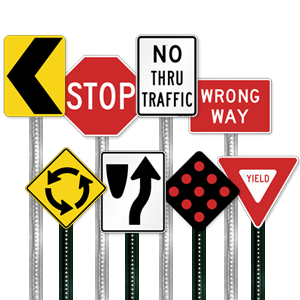
Public roads require standard MUTCD-compliant signs, but private property offers more flexibility. Custom stop signs can include additional text, facility-specific instructions, or company branding.
A warehouse might add “FORKLIFTS HAVE RIGHT OF WAY” below the stop message. A corporate campus might include specific speed limits or directional guidance.
3. All way and multi-way stop signs
These combine a standard stop sign with a supplemental plaque reading “ALL WAY,” “4-WAY,” or “3-WAY.” The plaque tells drivers that every approach to the intersection faces a stop sign.
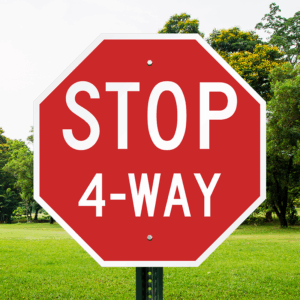
At all-way stops, the vehicle that arrives first proceeds first. When two vehicles arrive at the same time, the driver on the right has priority.
Where stop signs are used
Stop signs appear wherever traffic flow requires clear regulation. While public intersections are the most familiar application, stop signs serve important functions in many other settings.
1. Public roads and intersections
Stop signs control traffic at street intersections, T-junctions, and anywhere sight lines or traffic volume create collision risks. They’re also common at railroad crossings and highway on-ramps where merging traffic requires a complete stop before entering faster-moving lanes.
2. Parking lots and private property
Shopping centers, office complexes, apartment communities, and residential developments all use stop signs to manage internal traffic. While private property signs may not carry the same legal enforcement as public road signs, they establish clear expectations and help prevent accidents.
3. School zones and pedestrian crossings
Areas near schools frequently feature enhanced stop sign applications. Some include flashing LED borders or pedestrian-activated signals that draw extra attention when children are present.
Can you install a stop sign on private property
Yes, property owners can install stop signs on private land to manage traffic and establish clear expectations for drivers. However, there’s an important distinction: police typically cannot issue citations for ignoring stop signs on private property the way they enforce public road signs.
That said, proper signage demonstrates reasonable care in maintaining a safe environment. If an accident occurs on your property, having appropriate traffic control devices in place shows you took steps to prevent collisions, which can matter significantly in liability situations.
How to choose the right stop sign
Selecting the right stop sign involves matching a few key factors to your specific location and traffic conditions.
1. Selecting the correct size
Sign size corresponds to traffic speed and viewing distance. Parking lots and private driveways typically work well with 18″ or 24″ signs. Busier roads with faster-moving traffic call for 30″ or 36″ signs to give drivers adequate recognition time.
2. Choosing the right reflectivity grade
Consider your lighting conditions and when traffic is heaviest. High-intensity prismatic sheeting is worth the investment for locations with significant nighttime traffic or limited ambient lighting. Engineer grade may work for well-lit parking structures or areas used primarily during daylight hours.
3. Material options for durability
Most stop signs are made from aluminum, which offers excellent durability, light weight, and corrosion resistance. Aluminum signs typically last 10 to 12 years in outdoor conditions, sometimes longer in mild climates.
Frequently Asked Questions
Question 1. How many sides does a stop sign have?
Answer. Stop signs have eight sides, forming an octagon. This eight-sided shape is exclusive to stop signs in traffic control systems, which is why you can recognize them worldwide regardless of the language printed on them. The standardized octagon shape has been used since the 1920s to help drivers identify stop signs instantly.
Question 2. Can I put a stop sign on my private property?
Answer. Yes, you can install stop signs on your private property to control traffic flow and set clear expectations for drivers. However, police generally can’t ticket drivers for ignoring stop signs on private land the way they enforce violations on public roads. That said, installing proper stop signs on your property demonstrates you’ve taken reasonable safety precautions, which can be important if an accident occurs and liability questions arise.
Question 3. When should I replace my stop sign?
Answer. Replace your stop sign when you notice fading colors, reduced reflectivity at night, physical damage like dents or holes, or text that’s become hard to read. There’s no set replacement schedule—it depends on your climate and sign quality. Most aluminum stop signs with quality reflective sheeting last 10 to 12 years outdoors, though harsh weather, intense sun exposure, or vandalism can shorten their lifespan. Check your signs regularly, especially their nighttime visibility.
Question 4. What’s the difference between engineer grade and high-intensity prismatic reflective sheeting?
Answer. Engineer grade sheeting offers basic reflectivity at a lower price point, making it suitable for well-lit parking lots or low-speed private driveways where ambient lighting helps. High-intensity prismatic (HIP) sheeting reflects significantly more light back to drivers, providing superior visibility at night and lasting longer before needing replacement. If your stop sign will face regular nighttime traffic or sits in an area with limited lighting, HIP sheeting is worth the investment. Public roadways require HIP sheeting to meet MUTCD standards.
Category: Stop Signs
