
How to Use Traffic Signs to Stop “Near Misses” in Your Warehouse
You know the sound.
It’s the sudden, high-pitched “beep-beep-beep!” of a forklift in reverse, followed by a sharp “Hey, watch out!” It’s the sound of a 5,000-pound machine and a 180-pound person almost occupying the same space at the same time. Sometimes, it’s just the flash of a blue forklift safety light snapping into view a second too late.
In the warehouse world, we call this a “near miss.”
Too often, managers and supervisors breathe a sigh of relief and say, “Whew, that was close,” and then… nothing. But a near miss isn’t a lucky break. It’s a free lesson in failure. It’s a flashing red warning light, a data point that tells you a serious, reportable, and life-altering accident is statistically on its way.
If your facility is plagued by these “close calls,” the problem isn’t just “careless workers.” The problem is a lack of a clear, predictable, and visual system.
Your warehouse floor is a network of roads, intersections, and crosswalks. It’s time you started managing it like one. An effective warehouse traffic sign system is the single most powerful and cost-effective way to stop near misses before they become catastrophes.
Here’s how to do it right.
-
First, Treat “Near Misses” as Your Most Valuable Data
Before you buy a single sign, you must shift your company culture. The famous “Safety Pyramid” (based on Heinrich’s Law) shows that for every major injury, there are dozens of minor injuries and hundreds of near misses.
A near miss is not a failure of the worker; it’s a failure of the system.
When a near miss happens, don’t blame. Ask “why.”
- “Why did that forklift come around the corner so fast?”
- “Why was that pedestrian in the forklift-only lane?”
- “Why didn’t they see each other?”
The answer, more often than not, is a lack of clear, visual communication. This is where signs come in. Your goal is to move from a reactive (“Oops, that was close”) culture to a proactive (“That will never be close”) one.
-
The 3 ‘C’s of an Effective Warehouse Signage Strategy
You can’t just put up a stop sign and hope for the best. A truly effective warehouse safety plan is built on three core principles.
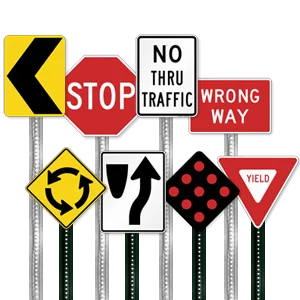
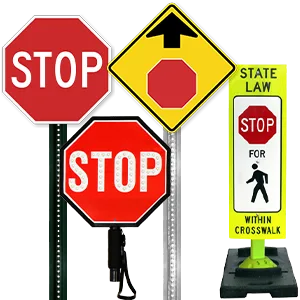
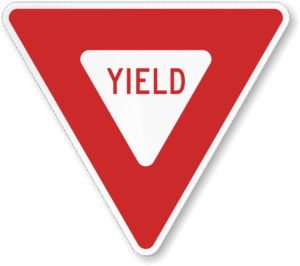
- Clarity: The sign must be instantly understood in less than a second. Use universal, ANSI/OSHA-compliant symbols. A red, octagonal STOP sign always means stop. A yellow, triangular YIELD sign always means caution. Don’t get creative; get clear.
- Consistency: This is the most critical rule. If one intersection has a stop sign for forklifts, every similar intersection must have one. If “Pedestrians Only” signs mean one thing in Aisle 1, they must mean the exact same thing in Aisle 10. Inconsistency breeds confusion, and confusion causes accidents.
- Compliance: A sign is not a suggestion. It is a rule. This means your signs must be backed by two things: training (so everyone knows what they mean) and enforcement (so everyone knows they are mandatory).
-
The 5 Essential Types of Warehouse Traffic Signs
Your signage needs to manage the behavior of two different groups: forklift operators and pedestrians. Here are the non-negotiable signs you need in your traffic management plan.
- Control Signs (STOP and YIELD)
These are your most powerful tools. Use them sparingly but with absolute authority.
- OSHA-compliant STOP Signs: Place these where a “rolling stop” is unacceptable.
- At the end of aisles before they merge with a main forklift “highway.”
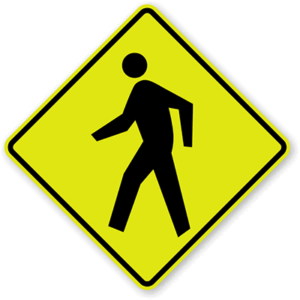
- At all pedestrian crosswalks (which should also be marked with pedestrian crosswalk signs).
- At blind corners where visibility is zero.
- Pro-Tip: A stop sign means a full 3-second stop. Wheels are not moving. This gives the operator time to look left, right, and scan for pedestrians before proceeding.
 Warehouse YIELD Signs: Use these for merging lanes where a full stop isn’t always necessary, but caution is.
- Where two aisles merge into one.
- When a side-aisle joins a main thoroughfare, giving the “right of way” to the main traffic.
- Warning Signs (Hazard Awareness)
These bright yellow warehouse warning signs prime the brain for a potential hazard, changing behavior before the person even sees the danger.
- Forklift Traffic Signs: This is for pedestrians. Place a “Caution: Forklift Traffic” sign at every single entrance to the warehouse floor and at doors leading from offices or break rooms. It tells them, “You are now entering a high-risk zone. Put your phone away. Look and listen.”
- Blind Corner Signs & Mirrors: This warns both drivers and pedestrians. When paired with a convex safety mirror, it’s one of the most effective ways to prevent corner collisions.
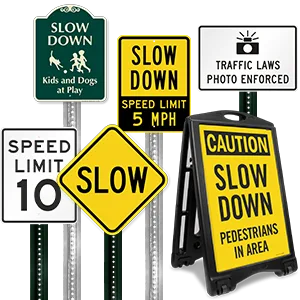
- Warehouse Speed Limit Signs: Yes, for forklifts. Posting clear 5 MPH speed limit signs removes all ambiguity. It gives you a clear rule to enforce.
- Pedestrian & Regulatory Safety Signs
Segregating traffic is the #1 way to improve safety.
- Pedestrian Walkway Signs: Use these signs to clearly mark “green zones” or safe lanes. This works best when combined with floor marking tape to create a clear visual boundary.
- “Pedestrians Prohibited” / “Do Not Enter” Signs: Use “Authorized Personnel Only” signs or “Do Not Enter” signs for high-traffic or narrow forklift-only aisles.
- “Look Both Ways” Signs: This sign is critical inside the pedestrian walkway, right before it crosses an aisle. Never assume a pedestrian sees the painted line.
- Durable Floor Signs: The Unsung Hero
Let’s be honest: many forklift drivers are looking at their forks, and many pedestrians are looking at their phones or paperwork. Durable floor signs put the message directly in their line of sight.
Anti-slip floor decals and signs are just as important as wall-mounted ones.
- Place large warehouse floor STOP signs or YIELD floor signs at intersections to reinforce the wall sign.
- Use floor-mounted pedestrian crossing signs (often a large “man” symbol).
- Use footprint-shaped floor decals to guide pedestrians along the safe path.
Modern Solution: Virtual projected signs are a fantastic high-tech option. They “paint” a bright, unmissable sign (like a virtual crosswalk or stop sign) onto the floor. They can’t be damaged by forklifts or get dirty, and they are highly effective in low-light areas.
- Enhancement Tools: Mirrors, Lights & Hardware
Sometimes, a sign isn’t enough.
- Dome & Convex Mirrors: Every blind corner or “T” intersection should have a large dome mirror or convex mirror. It turns a blind spot into a visible one and works in perfect harmony with your warning signs.
- LED Flashing Lights: At extremely high-traffic or noisy intersections, adding a motion-activated flashing blue light or warehouse safety light can grab an operator’s attention far more effectively than a static sign.
-
How to Make It All Work: Placement, Mounting & Training
You can have the best signs in the world, but they are useless if they are placed incorrectly or if your team ignores them.
- Placement & Mounting Strategy:
- Height: Signs must be mounted correctly, using the right sign mounting hardware like U-channel posts or brackets, so they are visible above stacked pallets but not so high they are out of the operator’s line of sight.
- Timing: Place a sign before the hazard, not at it. A stop sign should be placed far enough back from the intersection to allow a forklift to stop safely.
- No “Sign Clutter”: Don’t create “sign blindness.” Too many signs in one place will cause all of them to be ignored. Prioritize the most critical hazards.
- Training & Compliance are Non-Negotiable:
- Launch the System: Hold a mandatory safety meeting. Walk the floor with your team. Explain what every single new sign means and what the exact expectation is. “This OSHA STOP sign means your wheels are not moving for 3 seconds. No exceptions.”
- Lead by Example: The first time a manager or supervisor rolls through a stop sign, your entire system loses credibility. Compliance must start at the top.
- Connect it to Near Misses: Use your near-miss reports as a training tool. “We had a near miss at Aisle 4 last week. That’s why this new STOP sign and convex mirror are here.” This shows you are responding to real-world risks, not just adding rules.
Conclusion: Stop “Getting Lucky”
A “near miss” is a wake-up call. Don’t hit the snooze button.
By implementing a clear, consistent, and well-enforced warehouse traffic sign system, you change the very nature of your facility. You replace assumptions with rules. You replace chaos with predictability. You stop relying on “luck” and start designing for safety.
Don’t wait for the close call that isn’t. Use these “free lessons” to build a safer, more efficient, and more professional warehouse today.

Category: Road safety